
Guides
Renter Friendly Storage Ideas That Need No Drilling
Nov
You can add real storage to a rental without a single hole in the wall by using four zones that need no fixings at all, which are under the bed, the back half of deep cabinets, adhesive and tension mounts on walls and tile, and the inside of cabinet doors. Together those four hold more than most closets, and none of them put your security deposit at risk.
The reason renters end up with less storage than they are paying for is not square footage. It is that every obvious solution, meaning shelves, wall units and hooks, involves screws. So people stop looking, and the space stays empty.
Here is what works instead, zone by zone, with what each one holds and what it costs you in damage, which is nothing.
What you can add, and what it risks
| Zone | Roughly what it holds | Fixing needed | Deposit risk |
|---|---|---|---|
| Under the bed | 8 to 12 cubic feet | None, it is freestanding | None |
| Back of deep cabinets | 4 to 8 cubic feet | None, sits inside existing cabinets | None |
| Walls above waist height | Depends on the wall | Adhesive mounts | Low if removed correctly |
| Tile and glass in the bathroom | 2 to 4 cubic feet | Adhesive, no anchors | None |
| Counter and surface stacking | 1 to 2 cubic feet | None | None |
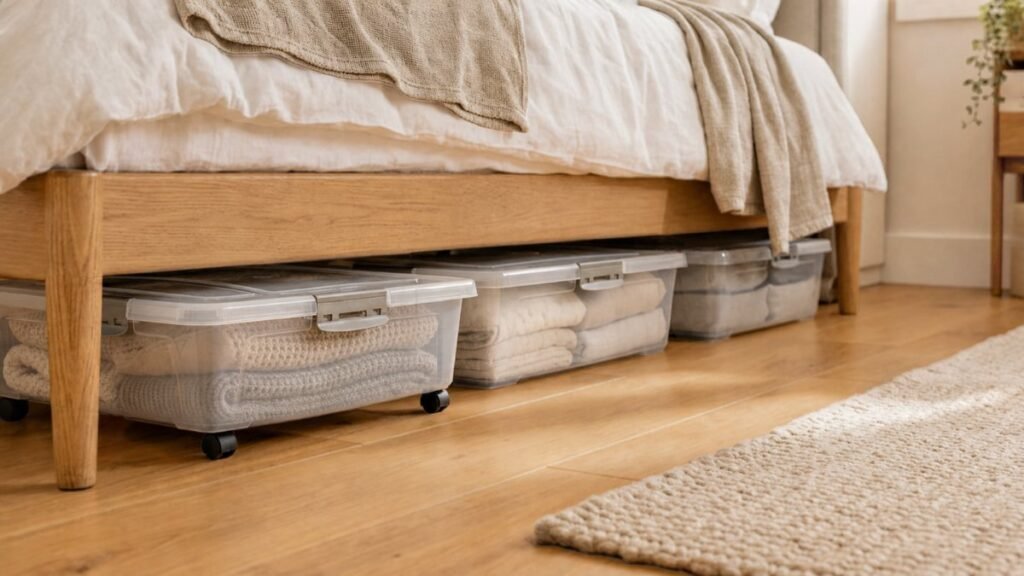
Under the bed, the biggest win and zero risk
This is the most storage anyone recovers in one afternoon, and it is the one zone where being a renter costs you nothing at all. A queen bed sits over roughly the same floor area as a small closet, and in most homes it holds dust.
What makes it work in practice is wheels. A container you have to drag out across carpet gets used twice and then forgotten. A 2-pack of rolling under bed storage containers slides out with one hand, which is the difference between a system you keep and a box you stop opening.
Put anything you touch less than once a month in there. Off-season clothes, spare bedding, shoes you wear occasionally, suitcases, gift wrap. Keep weekly items out of it, because even on wheels you will stop bothering.
Measure the gap from the floor to the bed frame before you buy. Most frames give between 6 and 12 inches, and that number decides whether the container fits or sits in the hallway until you return it.
Deep cabinets, where renters lose the most space
A 24-inch deep cabinet behaves like a 12-inch cabinet, because nobody reaches past the front half. Whatever is at the back has not been seen since the day you moved in, and in a rental you cannot fix that by adding shelves.
A pull out cabinet organizer in carbon steel solves it by bringing the back to you. It sits inside the cabinet you already have, needs no fixing and comes out when you leave. It is the single most useful thing you can put in a kitchen you are not allowed to touch, and it works just as well under a bathroom sink, which is the worst-organized square foot in most rentals.
Once you can reach the back of a cabinet you also need to see into it. A rechargeable under cabinet light or a 2-pack of motion sensor cabinet lights handles that. They mount magnetically, charge by USB and come on when the door opens. It sounds trivial, and it changes how much of a cabinet actually gets used.
Walls, without anchors
Wall space is the thing renters are most reluctant to use and the thing most worth using, because above about four feet almost every wall in the apartment is empty.
Adhesive mounting holds more than people expect, as long as you do two things. Clean the surface with rubbing alcohol first, not with a household cleaner, because residue is what makes adhesive fail. And wait the full cure time on the packaging before you load it, which is usually an hour and which everybody skips.
A wall mounted hook rack with 4 hooks by the door absorbs the coats, bags and leashes that otherwise live on a chair. One rack at the entry removes more visible clutter than an hour of tidying, because entry clutter is the clutter you see every time you walk in.
A wall mounted storage bag does the same for the small things that drift, meaning mail, chargers, remotes and whatever is in your pockets.
If you want the wall to do something nicer than hold objects, a galvanized 3 tier hanging planter puts three plants into the footprint of none.
The bathroom, where nothing can be mounted
Tile and glass are the surfaces renters are most afraid of, and they are also where adhesive works best, because they are smooth and non-porous.
A 2-pack of adhesive corner shower caddies gets bottles off the floor of the tub with no drilling at all. A touchless rechargeable soap dispenser frees up the sink edge, and a two chamber wall mount soap dispenser replaces two bottles with one fixture.
There is more on this in the piece on adding storage to a small bathroom, since bathrooms have enough particular problems to be worth their own list.
Surfaces, and going vertical on them
The last zone is the one nobody counts, which is the vertical air above a counter. Things that live flat spread sideways until the whole surface is gone.
Cosmetics are the usual culprit. A 3 tier makeup organizer turns a counter’s worth of sprawl into a stack you can see into, and it recovers most of the surface.
Bulk soft items are the other one. Comforters, coats and spare pillows each take a shelf and compress to almost nothing. A large foldable storage bag holds a season’s worth and folds flat when empty, which is the part cardboard boxes get wrong.
And if you work from the couch or the bed because there is no room for a desk, a foldable laptop bed table gives the laptop, the notebook and the mug one surface that disappears afterward.
Everything is in the Home collection.
How to take adhesive mounts off without damage
This is the part that decides whether renting and adhesive storage go together, and it is simple if you know it before you move out rather than on the day.
- Never pull straight out from the wall. That is what takes paint with it.
- Warm the adhesive first with a hairdryer on low for about thirty seconds, which softens the bond.
- Pull the tab slowly and straight down, parallel to the wall, stretching the strip rather than levering it.
- For stubborn residue, dental floss or fishing line sawed behind the mount works better than a scraper.
- Clean the mark with rubbing alcohol, not an abrasive.
Done this way, most adhesive mounts come off a painted wall with no mark at all. Done by yanking, they take a patch of paint and cost you more than the shelf was worth.
Where to start
One zone per weekend, beginning with whichever room annoys you most on the way in. Empty the zone completely before you organize it, sort into keep here, keep elsewhere and let go with no fourth pile, measure before buying anything, and leave about a quarter of the finished zone empty so it survives past month one.
If the bedroom closet is the bottleneck, which it usually is, start with the bedroom and closet piece instead.
Frequently asked questions
How can I add storage to a rental without drilling?
Use the four zones that need no fixings. Rolling containers under the bed, pull-out organizers inside existing deep cabinets, adhesive mounts on walls and bathroom tile, and vertical stacking organizers on counters. Between them they add more usable storage than most closets hold, and none of them leave anything behind when you move out.
Will adhesive hooks damage painted walls?
Not if they are removed correctly. The damage comes from pulling straight out, which lifts paint. Warm the adhesive with a hairdryer for about thirty seconds, then pull the tab slowly straight down, parallel to the wall, so the strip stretches instead of levering. Clean any residue with rubbing alcohol rather than an abrasive.
Why do adhesive mounts fall off?
Three reasons, in order. The surface was not cleaned with rubbing alcohol before mounting, so cleaning-product residue stopped the bond forming. The mount was loaded before the adhesive had cured, which usually takes about an hour. Or the weight exceeded the rating, which is easier to do than people think once you add what goes on the hook.
What storage gives the most space for the least money?
Under-bed containers on wheels. A standard queen bed sits over roughly 8 to 12 cubic feet of unused volume, which is comparable to a small closet, and recovering it costs less than almost any other storage purchase. Wheels matter more than capacity, because a container that is hard to pull out stops being used.
Can I use tension rods instead of drilling?
Yes, and they are the other no-damage option worth knowing. Tension rods work in any alcove with two solid opposing walls, which covers closets, under sinks and window recesses. Their limit is weight and wall strength, so they suit clothing, curtains and light items rather than books or crockery.
How much clearance do I need for under bed storage?
Measure from the floor to the underside of the bed frame and buy a container at least an inch shorter than that, because wheels and carpet both eat clearance. Most frames give between 6 and 12 inches. If yours sits lower than 6 inches, bed risers cost less than replacing the containers.
