
Guides
How to Make a Small Apartment Feel Warm at Night
Nov
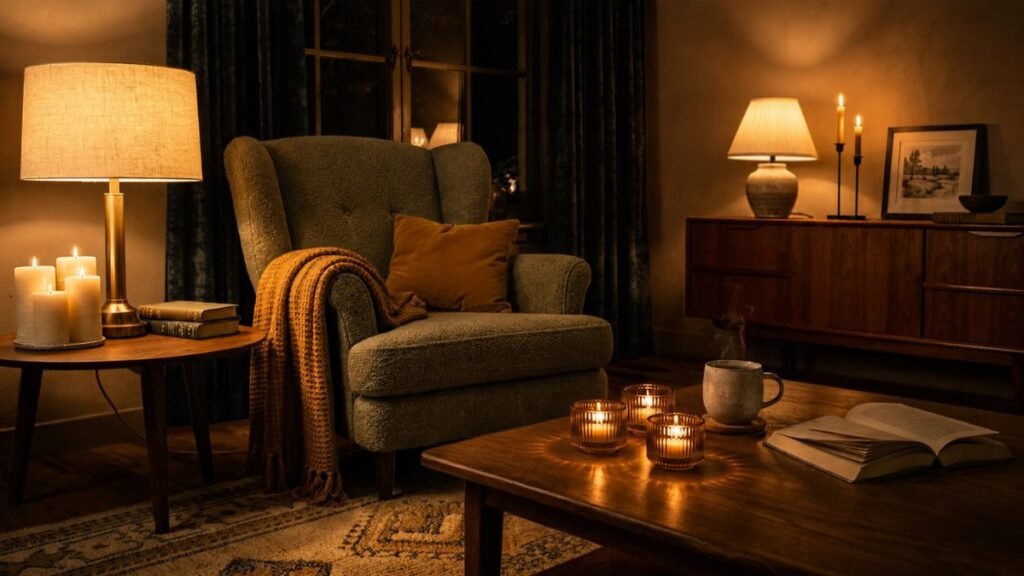
A room feels warm or cold to the eye before it feels anything to the skin, and the single thing that decides which is whether the light comes from the ceiling or from below eye level. Turning off the overhead light and replacing it with three low sources changes how a small apartment feels more than any object you can buy.
This matters from November onward because the sun is gone before most people get home, so the artificial light in the room is the only light there is for five hours a night, five months a year. In summer it barely registers. In winter it is the whole experience of being home.
The rule of three, and why ceiling light fails
Overhead light comes from one point, casts hard shadows downward and lights the middle of a room while leaving the edges dark. That reads to the eye as a small room, which is exactly what you do not want in a small room.
Three or more light sources below eye level do the opposite. They light the corners, they remove the shadows, and the boundaries of the room stop announcing themselves. The practical version is a lamp in two corners, something on a shelf or a table, and the ceiling light off.
| Position | What it does | Height |
|---|---|---|
| Corner of the room | Pushes the wall back, kills the shadow | Floor or side table |
| Beside where you sit | Reading light, warm pool | Elbow height |
| On a shelf or sideboard | Lifts the eye, adds depth | Above the furniture line |
| The ceiling | Flattens everything | Off, after dark |
What to put in each position
A gold geometric lantern lamp works in the corner or on a sideboard, because a lantern shape throws light sideways and upward rather than down in a cone, which is what fills a corner. A narrow matte black domed glass lantern wall light does the same job mounted, for a hallway or beside a bed where there is no surface to spare.
Beside where you actually sit, a bedside touch control table lamp is the one that gets used, because turning it on is a tap rather than hunting for a switch behind the shade. In a small apartment that lamp usually ends up beside the couch as much as the bed.
For the flicker, a 3-pack of flameless LED candles does what candles do to a room without an open flame on a shelf you walk past, which in a small space is the sensible version. A wooden soy wax candle covers the scent side.
One thing that becomes the center of the room
Rooms feel better when there is something to look at that is not a screen. For most of history that was a fire, and the reason people still respond to one has not changed.
A tabletop fire pit with roasting sticks is the apartment-scale version of that. It sits on a table, it gives a real flame to look at, and it turns an evening into an occasion without anybody leaving the building. Use it on a heat-safe surface with the window cracked, and never leave it unattended, which is the same rule as any open flame indoors.
For a different kind of focal point, a 2 in 1 holiday projector light throws pattern across a wall or ceiling, which fills a blank wall that has nothing on it and costs less than framing anything.
Warmth is a temperature of light, not only of air
Bulb color temperature does more work than people realize. Cool white light at 4000K and above reads as an office. Warm light at 2700K and below reads as evening. If a room feels clinical no matter what you put in it, the bulbs are usually why.
The other half is scent and air. A Cornucopia aromatherapy humidifier handles both at once, since heated winter air is dry and dry air feels colder at the same temperature. Keep humidity between 30 and 50 percent, because above that you are creating damp.
And if you want the glow outdoors on a balcony or a window ledge, Dew Droplets solar string lights charge during the day and come on by themselves at dusk, which is about the time anybody wants them.
Everything is in the Lighting collection.
What this costs and what order to do it in
Start with the free part, which is turning the overhead light off after dark and seeing what the room already has. Most apartments have one or two lamps that are simply in the wrong place. Move them to the corners before buying a third.
Then change the bulbs to warm white, which costs very little and changes everything. Then add the third source. Then, if the room still has a dead corner or a blank wall, fill it.
If the cold is the problem rather than the light, the piece on heating a cold apartment when you cannot touch the thermostat covers that side.
Frequently asked questions
How do I make a small apartment feel cozy in winter?
Turn off the ceiling light after dark and replace it with at least three light sources below eye level, placed in the corners and beside where you sit. Overhead light flattens a room and leaves the edges dark, which makes a small space read as smaller. Warm bulbs at 2700K or below, one thing to look at such as a flame or a projected pattern, and humidity in the 30 to 50 percent range do the rest.
Why does overhead lighting make a room feel worse?
Because it comes from a single point above, casts hard downward shadows and lights the center while leaving the perimeter dark. The eye reads unlit edges as the boundary of the space, so a room lit from the ceiling looks smaller and colder than the same room lit from several low points.
What color temperature is best for a cozy room?
2700K or below, usually sold as warm white or soft white. Anything at 4000K and above reads as cool and institutional, which is correct for a kitchen counter and wrong for a living room in the evening. Changing bulbs is the cheapest meaningful change you can make to how a room feels.
How many lamps does a small room need?
Three light sources is the usual threshold where a room stops looking flat, and they matter more by position than by number. One in a corner, one beside the seating at about elbow height, and one higher up on a shelf or sideboard. Many apartments already own enough lamps and simply have them all in one half of the room.
Are tabletop fire pits safe indoors?
They are designed for indoor use, and the same rules as any open flame apply. Put it on a heat-resistant surface with clear space around it, keep it away from curtains, paper and anything that hangs, crack a window for ventilation, and never leave it burning unattended or while anyone is asleep. Keep it out of reach of children and pets.
Does humidity change how warm a room feels?
Yes. Heated air holds less moisture, and dry air feels colder at the same measured temperature while also drying out skin and throats overnight. Bringing indoor humidity into the 30 to 50 percent range makes a room feel warmer without touching the heating. Above 50 percent you start risking damp and mold, so more is not better.

Pingback: How to Host the Holidays in a Small Apartment