
Guides
How to Work Out in an Apartment Without Annoying the Neighbors
Nov
The noise that travels to the apartment below is impact noise, not sound, which means it comes from your feet and from dropped weight rather than from how loudly you breathe or how loud the music is. Cut the impact and you can train at seven in the morning in a top-floor apartment without anybody downstairs knowing.
That distinction matters because most people solve the wrong problem. They turn the music down and keep jumping. The music was never the issue. A single jump transmits a thud straight through the floor structure into the ceiling below, and no amount of volume control changes that.
What the neighbor downstairs actually hears
| What you do | What they hear | Fix |
|---|---|---|
| Jumping, burpees, jump rope on the floor | A heavy repeated thud | Replace with no-impact movement |
| Dropping or setting down weight | A single sharp bang | Lower it, or use equipment with no loose weight |
| A treadmill | Continuous rumble and motor vibration | Not an apartment machine |
| Bodyweight floor work | Almost nothing | Nothing needed |
| Music and breathing | Almost nothing through a floor | Nothing needed |
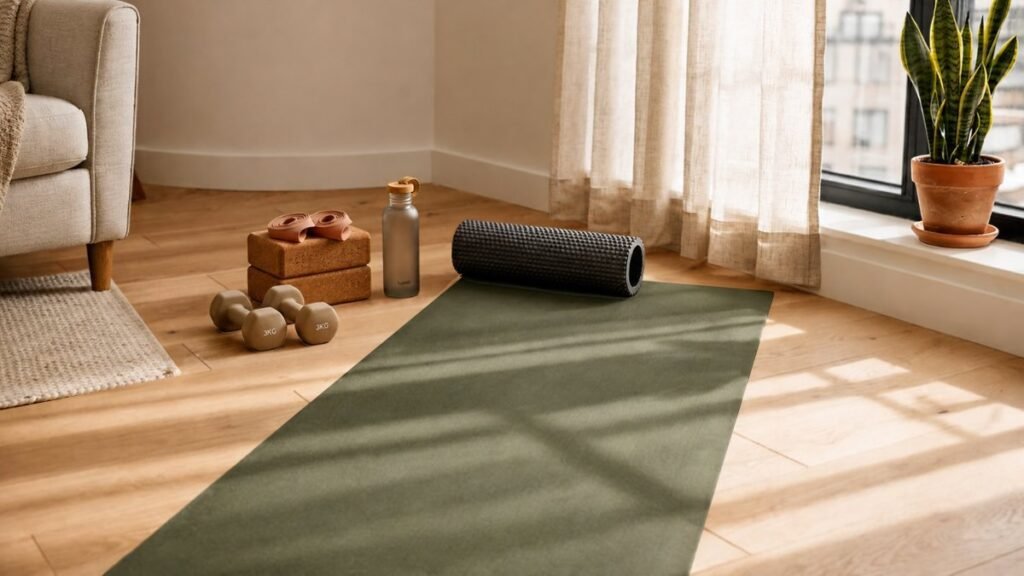
A thick mat under everything helps with all of it and is the cheapest single intervention available. It will not make jumping silent, but it takes the edge off everything else.
Cardio with your feet on the ground
Cardio is where the noise comes from, so it is where the substitution has to happen.
A vibration exercise machine is the quietest real option. You stand on it, there is no impact at all, and it is the right choice for a top-floor apartment, for anyone coming back from an injury and for anyone with joints that do not tolerate jumping. It also needs about two square feet.
If you want the jump-rope motion, an electronic jump rope is a cordless rope with weighted handles, so there is no rope hitting the floor and no ceiling clearance needed. It is quieter than a real rope but it is still jumping, so use it over a mat and keep it out of early mornings and late nights.
Everything else can be bodyweight, and the no-impact list is longer than people assume. Squats, lunges, step-ups onto a sturdy surface, slow mountain climbers, wall sits and shadow boxing all raise a heart rate without either foot leaving the ground hard.
Strength without dropping anything
Loose weight is the other noise source, and it is the one that generates actual complaints, because a dropped dumbbell is a single loud bang rather than a rhythm somebody can tune out.
An automatic rebound ab roller wheel is silent by design, since nothing leaves the floor and nothing gets set down. The rebound mechanism assists the way back up, which is the part that makes a standard ab wheel unusable on day one for most people. It works the whole midsection, stores under a couch and costs a fraction of any weight set.
Pair it with push-ups, squats, lunges, planks and glute bridges, none of which make a sound and none of which cost anything. In an apartment, bodyweight is not the compromise option. It is the correct option.
The part that decides whether you keep going
Home routines usually break in week two, and not from lack of motivation. You train hard on Monday, you are too sore on Tuesday and Wednesday, and by Thursday the habit is gone. Recovery equipment is not a luxury here, it is what makes tomorrow’s session happen.
A Stretch ‘N Relax kit covers the stretching people skip, which is exactly what keeps the next day workable.
For muscle that is already sore, a Mighty Massager deep tissue tool handles the large groups like quads, hamstrings and back. A palm size massager with several strength settings is the one that fits in a bag and actually gets used, and a Pulse P3 portable massager does the same job.
An acupressure mat is the rest-day item. It does nothing unless you lie on it for fifteen minutes, which is the behavior it is really buying.
And if your feet take the load, whether from running or from standing all day at work, a roll on sole foot massager solves a small problem that otherwise ends training weeks.
Everything is in the Sports & Outdoor collection.
Where to put it in a small apartment
Storage decides use. Equipment in a closet is equipment you forget you own, and a basket in the corner of a room you already sit in gets used far more than a tidy cupboard does.
The three pieces together, meaning one cardio item, the ab roller and the recovery kit, fit in a single basket and need about a yoga mat of floor. If even that is a problem, the piece on renter friendly storage that needs no drilling covers where to put things in a small rental.
Two more things that hold a routine together. Pick a fixed time rather than deciding daily, because the decision is what gets skipped. And start at ten minutes, since a short session done five times beats a long one done once and then dreaded.
Frequently asked questions
How can I work out in an apartment without disturbing downstairs neighbors?
Eliminate impact rather than volume. The noise that travels through a floor is impact noise from feet and dropped weight, not airborne sound from music or breathing. Replace jumping with squats, lunges, step-ups and slow mountain climbers, avoid loose weights you might set down hard, and put a thick mat under everything. Done that way, a workout is effectively inaudible below.
What is the quietest home cardio equipment for an apartment?
A vibration platform, because there is no impact at all, and bodyweight circuits, which make no noise by definition. A cordless jump rope is quieter than a corded one and needs no ceiling clearance, but it still involves jumping, so it belongs on a mat and outside early mornings. A treadmill is the loudest option and is generally a poor fit for an upstairs apartment.
Can you use a treadmill in an apartment?
You can, but it is the piece most likely to generate complaints. A treadmill produces continuous rumble and motor vibration that transmits through the floor structure, it takes a permanent footprint of around 20 square feet, and it is hard to move out later. In a small upstairs apartment a vibration platform or bodyweight cardio achieves the fitness goal without the conflict.
Does a mat actually reduce noise for neighbors?
It reduces it, and it does not eliminate it. A thick mat absorbs some of the energy from footfalls and stops equipment contact noise, which makes a real difference for floor work, an ab roller and general movement. It does not make jumping quiet, because the force of a jump transmits through the structure rather than just across the surface.
What equipment do I need for a small apartment workout?
Three pieces cover it. One for no-impact cardio, such as a vibration platform. One for strength, such as an ab roller, alongside bodyweight work that needs nothing at all. And one for recovery, such as a stretching kit or a massage tool. Together they fit in a basket and need about a yoga mat of floor space.
What time of day is acceptable to work out in an apartment?
Most residential noise rules treat roughly 10 p.m. to 7 a.m. as quiet hours, though the exact window varies by city and by lease. If your routine is genuinely low-impact, time matters much less, which is the real advantage of removing jumping from it. If you do include impact work, keep it to the middle of the day.
